


— Ah, would you like us to talk about retrocausality? — asked Pyotr Petrovich with undisguised enthusiasm in his voice, having previously been briskly pacing across the veranda in an elegant light-brown summer suit with a small brown stripe. He sat down heavily in a wicker rocking chair, crossed his legs, and lightly smoothed his pointed goatee.
“I love retro…” Olesya said slowly, drawing out the vowels in her words, with detached resignation. She was a refined blonde in a long milky-white evening gown, sipping champagne from a glass and giving the scientist a look more weary than languid. She leaned back wearily in her chair and lit a thin lady’s cigarette.
“Retro? That’s wonderful!” Sazhin smiled.
“You know, Peter…” the girl said just as leisurely and thoughtfully, pronouncing each letter carefully, “it feels as if we’re here… like Adam and Eve…”
“You think so?”
“Yes… definitely… this is our Eden…” And then she added, “What do you think?” Olesya practically exhaled each word along with the tobacco smoke.
“I still prefer to think of it as Olympus.”
“Oh… In that case, I’ll be Aphrodite, and you…” She paused meaningfully, slightly longer than usual, “you are definitely Mars… my god of war…”
“Ares,” corrected Sazhin, “Mars was the Roman god, not the Greek one.”
“Oh, dear, Peter… how… all of this… is terribly boring…” She took a deep drag from her cigarette and rolled her eyes, “You know what, Peter… Give me a lake.”
“A lake?”
“Yes… a lake…” Olesya smiled dreamily, “We’ll sail on it in a boat… I’ll take a sun umbrella… And there will be swans… You are my god, after all… You can give me a lake, Peter?”
“Easily,” Sazhin replied firmly, “Just show me exactly where.”
Olesya opened her eyes and lazily waved a slender hand toward the forested hills.
“I want it there… by the hills…”
“As you wish,” Pyotr Petrovich replied with a slight smile, stood up, walked over to the portable terminal laid out on the nearby table, and entered the coordinates.
Within minutes, three 50-kiloton charges fell one after another from the sky directly onto the spot Olesya had indicated, sending cubic meters of earth soaring upward. The slightly elongated fiery hemisphere momentarily blinded the sleepy-eyed girl so much that she even pretentiously covered her eyes with her hand. A shockwave spread concentrically across the green sea of falling and swaying trees. A swirling cloud of explosion gradually began to rise above the hills in the form of a giant, bizarre mushroom.
Sazhin stood with his arms crossed over his chest, calmly looking into the distance, where this majestic scene was unfolding. Olesya raised her languid eyes to him and, still slowly stretching out the vowels in every word, asked:
“Peter… do we still have any caviar left?”
* * *
The colonel approached the window and mechanically pulled the heavy burgundy curtain tighter. The office was dimly lit. Only a lamp with an old-fashioned round green shade created a bright circle of light on the table.
“What do you yourself think about this?” asked the tired general, abruptly closing the thick folder lying in front of him.
“There are serious grounds to believe that the technology will be used for military purposes. According to our data, DARPA is planning funding…”
“Serious grounds? DARPA is planning… What if it’s just another hoax?! If they’re trying to trick us again like rabbits into yet another damned SDI?! We need real data!”
“I’m not a scientist… Our analysts have reflected their considerations in the report,” replied the colonel dryly, sitting up straight and freezing in his chair as if standing at attention.
“Considerations, damn it… If we keep considering things for so long, we’ll soon shit ourselves, colonel! And at best, we’ll lose these stars… And first and foremost, you!” The general demonstratively tapped his finger on the epaulette and, pausing briefly, exhaled, “Just find a proper specialist already…”
“There’s one option… One authoritative expert. He wasn’t directly involved in the work. He could even be sent legally…”
“Get him from under the ground! However you do it, deliver the task. And then he must be there… Extract everything possible from there… Even if it’s a blind horse! But then tell me clearly: yes or no.”
“Yes, sir!”
The colonel straightened up even more and hurriedly left the office.
* * *
Pyotr Petrovich Sazhin strolled leisurely along the line of palm trees neatly planted along the coast, admiring the ocean and breathing in the cool salty air. Somewhere over there, on the other side of the Atlantic, in the darkness of the approaching night, lay his homeland, but Pyotr Petrovich did not feel nostalgia now. He was glad that for these short 10 days he had managed to break free from the usual whirlwind of his daily routine and come to the conference of theoretical physicists. And now, dressed in orange Bahamian shorts and a colorful Hawaiian shirt, he was here, sipping a cocktail, looking at the ocean and truly enjoying himself.
There was about half an hour left before the start of the last lecture, so Sazhin took another walk along the promenade, and then, with the same relaxed gait, entered the hotel building and went straight up to the conference hall without going to his room.
At a small podium in front of a large screen onto which tables and diagrams were projected, stood a young woman, slightly pressing her thin hands against her body and nervously shuffling papers on the table in front of her. It seemed unlikely that she would be able to utter a few sentences due to nervousness, but as soon as she began her presentation, she immediately transformed. She suddenly acquired a certain determination and even firmness.
Her topic was theoretical physics. Pure fantasy, as true experimental physicists would say. Tachyons and tachyon fields. That’s not what they usually deal with, but the girl was very passionate about it. Completely absorbed in her idea, she enthusiastically wrote formulas on the electronic whiteboard.
“And so… getting rid of the complex denominator, we see… that the delta-T-zero vector can be rotated by an angle phi greater than 90 degrees… and its time-axis component turns out to be negative. The process has begun… in reverse.”
The girl finished and surveyed the half-empty hall through her thin glasses. Among the few listeners, she made eye contact with Pyotr Petrovich and, seeing his approving nod, responded with an embarrassed smile.
* * *
Olesya sat in a rocking chair, gently swaying back and forth, flipping through the colorful pages of some old glossy magazine. In the morning, she had not found Sazhin nearby, so she decided to postpone their shared breakfast and wait for him on the veranda. But time passed, and Pyotr Petrovich still did not appear. The girl tore her gaze away from the text and pictures and looked anxiously into the distance…
Above the forest and hills, the sky was blue and somehow weightless; broken treetops were illuminated by the still-warm rays of the sun, which grew weaker with each passing day. Olesya felt the approach of a cold wind in a peculiar way. From somewhere in the west, a heavy dark cloud was creeping closer, driven by it.
Sazhin appeared suddenly. Dressed in a protective suit, looking like a character from a worn-out post-apocalyptic movie, he dragged a large metal-clad box closer to the house and began fiddling around near it, trying to open it.
Not hiding her joy in her voice, the girl called out to him from the veranda:
“You’re here! My rescuer… I was worried…”
The scientist silently glanced at the girl through the tinted lenses of his gas mask, finally opened the box, and, taking several rectangular packages from it, climbed up to the house.
“Is there something… tasty?”
“Military rations,” Sazhin replied dully from inside the suit, “a two-week supply.”
“Oh… um…” Olesya’s mood slightly soured, but the scientist suddenly pulled out a bright package from his pocket and handed it to her. “Chocolate?! Really… Thank you… I love it so much…”
She innocently and sincerely grabbed the bar with her thin trembling fingers and now twirled it in her hands, rejoicing like a child.
“We should go inside if you don’t want to get a little sunburned,” Sazhin remarked gloomily, removing his gas mask, “a storm front is approaching, and it will bring a lot of radioactive dust.”
“Yes… Of course… I’ll help you with this… food. And then… we’ll have breakfast… I’ll make coffee…”
* * *
Pyotr Petrovich added another sugar cube to the latte brought by the waiter and, carefully stirring it, quietly addressed the girl sitting opposite him.
“You really liked my presentation. It seemed very interesting to me.”
“Do you always invite girls for a cup of coffee and say that after being impressed by their intelligence and beauty?” the scientist’s companion asked playfully.
“In fact…” the scientist paused, “I always invite for coffee girls who give presentations on tachyon fields.”
“I’ll remember that.”
“And yet…” Pyotr Petrovich cautiously glanced around and, making sure they were completely alone in the café, continued, “Have you ever tried putting your theories into practice? Have you conducted an experiment?”
“You speak as if you’re a conspirator,” the girl remarked with a quiet smile, “we’ve only known each other for half an hour, and already… First, you practically drag me out of the hotel. You bring me to this café on the embankment. And you’re Russian too… It’s noticeable from your accent.”
“You’re Russian too, Olesya Mikhailovna,” Sazhin replied calmly, switching to his native language, “it’s noticeable from your badge.”
Olesya awkwardly unclipped the plastic name tag from herself and hid it in her bag.
“I haven’t spoken… in Russian… for a long time,” the girl slowly searched for words, “but now… we both… look… like conspirators. Could we be… overheard?… By whom?… C… R… U?…” She silently articulated the last letters with her lips for extra importance.
“Don’t worry,” Sazhin smirked, “I’ve already put poison in your cup. Just in case.”
Olesya burst out laughing.
“What an original spy you are,” she said, looking directly into her companion’s eyes, “So what do you… want?… To recruit me? Or… to seduce me?”
“If the Motherland orders…” the scientist became more serious, “you were born in Canada, studied in Massachusetts, and now work in New York. Your parents are long gone… Is there something or someone keeping you in this country?”
“I see you’re well informed… about me,” Olesya frowned, immediately changing her expression and tone, “but then you must know… that I’m the great-granddaughter of an officer… And our family… has its own… old scores…”
“The White émigrés. I understand…” Sazhin took a sip of his cooling coffee, “but you can’t fail to realize that those times are long past. Governments change, but Russia remains Russia… Your great-grandfather would understand me. And you probably inherited from him…”
“I’m a cosmopolitan,” the girl interrupted him.
“In that case, even better,” Pyotr Petrovich smiled and leaned back in his chair, “then we can talk exclusively as business people.”
“This all seems… like some kind of silly joke…”
“No jokes.”
“I don’t think… we’ll manage… to have a conversation.”
“And yet. What do you want? I’m not sure DARPA can offer you everything you need.”
“You even know about DARPA’s offers?”
Sazhin nodded affirmatively.
“I researched the matter before flying here and meeting you personally. Here it will be just one of many small projects, while with us you can count on systematic state support,” the scientist paused, imagining for a moment the scale of funding and all the possibilities of its use, “so, I’m ready to offer you a job and all the conditions for it. Any resources and materials. And potentially the opportunity to confirm all your theories.”
“Well… okay… And in return?” Olesya looked at Sazhin intently.
“But there’s no… prototype… There isn’t even an experimental setup…”
“You’ll make it,” Pyotr Petrovich answered confidently, “and I’ll help you.”
* * *
The entire following year for the heiress of White émigrés passed “under the sign of change and new discoveries.” At least, that’s what the horoscope reported in one of the local newspapers printed on cheap gray paper, occasionally leaving traces of poor printing ink on hands. Of course, Olesya didn’t believe in horoscopes, but this prediction seemed accurate and ironic to her.
She crumpled the paper and carefully placed it between a black power cable and the shiny surface of a copper cooling tube.
“Interference is gone!” came a satisfied voice from the next room.
“The feed was buzzing… onto the refrigerator,” the girl replied, “we need to move the cable… further away.”
Yes, this was not how she had imagined her historical homeland. It lacked the old-fashioned authentic style “à la russe” that Olesya had absorbed since childhood from French translations of classical Russian literature. Furs, voluminous dresses, champagne, hussars, balls, and horses harnessed in troikas galloping through endless snow-white winter landscapes at breakneck speed to the frantic rhythm of a mazurka had melted away like a child’s fantasy.
However, she did not find here either the gray Orwellian totalitarianism that frightened her so much, ready to tear apart and trample all human feelings and aspirations under the iron heel of a military boot. Majestic cities and impressive factories built thanks to superhuman enthusiasm and the concentration of huge masses of people. Rows of people led by rigid militaristic ideology and bound by fear imposed by a punitive machine of suppression. All these disturbing dark fantasies of the girl crumbled into dust and dissipated like a nightmare that always becomes more ridiculous than frightening with the arrival of morning.
Instead, she found herself in a small military town surrounded by forests and hills, where several modern houses built using Finnish technology were attached to aging concrete buildings and an airstrip, along with several military warehouses.
A research center was organized in one of the old buildings and, nevertheless, stood out among them by being neatly painted both outside and inside with fresh paint. Its above-ground and underground floors were filled with equipment of Western manufacture—neither the newest, but still decent. And the small research group, headed by Pyotr Petrovich Sazhin, consisted of generally good and pleasant people.
Olesya’s eyes quickly adjusted to the sights of the local nature, the twilight lasting almost half a year, which formed the drawn-out working days.
What everyone had been waiting for happened on Thursday at 2:08 PM. The girl, as usual, turned on the recording equipment and switched the device to reception mode, but instead of the usual noise and crackling, she suddenly heard a barely noticeable steady hum in the silence. She checked the connections again, but there was no mistake. Some kind of signal was being transmitted to the equipment. Her colleagues leaned intently toward the instruments, tense with anticipation.
Suddenly, a sequence of pulses burst into the silence, representing a series of numbers… 1.. 6..1.. 8..0.. 3.. 3..
“The golden ratio,” Olesya blurted out, turning to Sazhin, who stood with a stony expression.
“I hear it,” he said in a strained voice. Every morning, as part of a series of experiments, he would open a reference book, choose a random constant, and send a sequence of numbers in the form of a laser beam through a tachyon field generator, after which they would try to reverse the process.
Each day the number was different—gas constant, Avogadro’s number, pi, Planck’s constant… And every time they wrote them down on the board at the end of the day. But phi, the so-called “golden ratio,” was not there yet, because it had not been attempted to transmit it. There was no doubt about it. They would transmit it… tomorrow. On Friday at 9:04 AM. The signal would enter the tachyon field and, bouncing back in time, be received today, on Thursday at 2:08 PM.
* * *
“To be honest, I didn’t believe you and your American protégé would succeed,” the colonel said cheerfully, walking briskly down the corridor.
“I’m glad we didn’t live up to your expectations,” Sazhin replied just as cheerfully, and both laughed.
“Certainly, more tests will be needed. We need to be sure of its reliability… But even now it’s clear that your discovery will be used in intelligence. Receiving data from the future is invaluable. Even in the General Staff there are thoughts… cautious thoughts—to use your device as part of the Perimeter system, as an element for extremely early detection of nuclear attack threats. Our geopolitical partners across the ocean will start getting nervous!”
“That’s wonderful, but unfortunately, it’s a complete waste of time,” Pyotr Petrovich remarked.
“What do you mean?!” the colonel stopped abruptly, catching the scientist by the sleeve and holding him back, “explain!”
“Don’t you think,” the scientist smirked, “that it will take the Americans a long time to replicate the device? If we stop at the current stage, it will simply trigger another round of the arms race, but nothing will change.”
“What do you suggest? Specifically.”
“We need to create a fundamentally new weapon. Increase the power of the device. Mount it on the nose cone in front of the warhead. We won’t be sending a signal about a missile attack into the past, Colonel. We’ll send the missile itself into the past. It can’t be detected or intercepted. It will reach its target earlier than it was launched! By an hour, a day, maybe even a month earlier…”
The colonel stared intently at Sazhin, catching every word and feverishly thinking whether the man before him was a madman or a genius.
“Alright,” he finally replied, “we’ll think about your proposal.”
He left the scientist standing in the corridor and hurried away himself. At the very end, he glanced back at Pyotr Petrovich and absentmindedly repeated, “We’ll definitely think about it… And you keep working. Keep working…”
* * *
The house, significantly expanded and reinforced over the past couple of years, had been transformed by Sazhin into a real bunker. Air and water filtration systems, sealed doors and windows, walls and ceilings reinforced with steel beams. The owners were definitely preparing for possible threats.
However, the interior was not solely dedicated to utilitarian purposes. Homemade shelves running along the walls held books, small vases, figurines, and similar knick-knacks. Nearby hung a “masterpiece” by an unknown artist, an imitation of Ivan Aivazovsky, where a sailing ship was depicted simply but meticulously in oil on canvas. On the floor lay a large carpet with a long pile. A sofa, a couple of armchairs, a coffee table, and a floor lamp with a blue fabric shade completed the picture of provincial comfort.
How and where Olesya managed to get all the things necessary to create this coziness, she sometimes didn’t even know herself. But now she sat in an armchair, her legs tucked beneath her, wrapped in a warm blanket, thoughtfully flipping through a volume of Tolstoy.
“Pyotr,” she finally looked up from the pages and addressed Pyotr Petrovich, lying on the sofa with his eyes closed, “are you asleep?”
“I’m awake now,” Sazhin replied without opening his eyes.
“You know… I’m still worried about… one question… Why did the United States… decide to strike first? Could it be… that they were so afraid… of our test?”
Pyotr Petrovich suddenly remembered that last day of their previous life…
* * *
— Five-minute readiness announced, — said the colonel into the microphone. Everyone in the command center froze in their places: — Is telemetry data from Novaya Zemlya still not coming in?
— Not yet, comrade colonel! — replied the lieutenant monitoring the instruments.
The colonel glanced through the glass at the launch pad, where a black rocket stood motionless in anticipation. He glanced once more at his watch and raised his hand toward the button… In the silence, the phone on the secure line rang, and the colonel picked up the receiver.
— Reporting… target hit, — came the distorted, crackling voice of an observer at the control point.
— Telemetry’s coming through! — the lieutenant exclaimed excitedly, — delay is two minutes from the calculated time.
— What’s going on with your transmission? The automation is showing a two-minute delay! — the colonel shouted over the static crackling in the receiver.
— I can’t know… — replied the observer, — the rocket arrived two minutes late.
The colonel turned to Sazhin, who calmly stood with his hands in the pockets of his white coat, smiling slightly. He looked puzzled.
— What does this mean, Pyotr Petrovich?
— Everything’s fine, — he replied, — you were distracted by the phone call.
— Damn it… — the colonel suddenly realized what had happened and quickly pressed the launch button.
The rocket shuddered and, soaring into the sky, disappeared into a bluish glow. The command center erupted in applause.
Despite this amusing and somewhat amusing incident, the test was declared successful. The military and scientists went back to their duties. Twilight began to gather over the launch site.
— Interesting, — the colonel asked Sazhin when they were left alone in the command center, — what would have happened if I’d pressed the button even later?
— I don’t know how to explain it to you, colonel, — the scientist replied, — but physics answers this question like this: in this situation, you couldn’t have pressed the button either two minutes earlier or two minutes later.
The military officer thought about it silently. At that moment, an alarm signal sounded. Encrypted messages scrolled across the terminal screen. Pyotr Petrovich knew what they meant. It was an early warning system activation; the alert wasn’t a drill, enemy missiles had already been launched at predetermined targets. He grabbed a portable terminal box from the table and, without hesitation, together with the colonel rushed out of the command center. Pausing for a second at the exit, as if feverishly making the right decision, he quickly headed toward the research building.
— Sazhin! Where are you going? The bomb shelter is the other way! — came a voice from behind, which Pyotr Petrovich ignored.
— Ah! — the colonel waved his hand helplessly, deciding not to waste time on the obviously panicked scientist, and hurried off in the opposite direction.
At the research building, Pyotr Petrovich encountered a group of soldiers and colleagues rushing to evacuate. Grabbing Olesya by the scruff of the neck, he dragged her through the crowd toward the checkpoint.
— Where are you going? What’s happening?! — the girl exclaimed as soon as she was inside the cab of a military UAZ vehicle, while Sazhin tried to start the engine with trembling hands.
— We’ve gone too far! That’s what’s happening! — the car finally obeyed, roaring aggressively to life and pulling away.
Trees flashed past in the headlights. The UAZ bounced over potholes on the narrow forest road. Finally, Sazhin drove onto a smoother dirt road and sped away from the military town.
— Are we running away? Wouldn’t it be safer… to stay? — asked Olesya.
— No. Our complex will be one of the primary targets, — the scientist replied, not taking his eyes off the road, — the flight time for the main warhead grouping is 24 minutes. During this time, we must get as far away from the epicenter as possible.
— And then… what? Will there be… further…
— If our generals don’t manage to hide and die, or simply freeze up and do nothing, the Perimeter system will do everything for them. Ideally, the missiles have already taken off to deliver a retaliatory strike. Considering the latest advances in delivery systems, only a minimal number of warheads will be intercepted on both sides, meaning mutual annihilation is practically inevitable…
Sazhin was interrupted by a dazzling flash brighter than daylight, illuminating at least half the sky behind them and filling all the space around.
* * *
Pyotr Petrovich opened his eyes and carefully looked at Olesya sitting opposite him.
— I don’t think they were scared. Especially since I studied archival records from seismographs and satellites.
— And what?
— The first explosion occurred on US territory. Apparently, we struck them.
— It can’t be… Russian generals… couldn’t have been so… insane…
The scientist got up and sat down on the sofa.
— I didn’t mean the Russian generals. I meant you and me.
— This is some kind of… mistake.
— There’s no mistake, — he stood up, walked to the far corner where his desk was located, and took a printout from it, — remember our little game with famous constants when we were still developing the device?
Olesya nodded silently, watching Sazhin closely.
— And here’s what that missile, which appeared in the sky above Northern California three years ago, transmitted over our closed channel, — he handed the sheet to the girl.
It contained a deciphered signal consisting of a series of numbers: 1.. 6..1.. 8..0.. 3.. 3..
— I… don’t understand… — Olesya stammered fearfully, — what does all this… mean?!
— It’s a signature. Our signature. Or a confession. Or a message to ourselves.
— But why?… Why would we do something like this?…
— I don’t know. Maybe we wanted to create a wonderful new world for ourselves out of the ruins of a global nuclear war. Or maybe we just wanted to kill ourselves, sitting in a night cafe on the coast discussing tachyon fields. It doesn’t matter anymore…
— My God… Pyotr… And you’ve been silent all this time? — she also got up and tried to pour herself a glass of wine from the bottle standing on the sideboard, but it turned out to be empty.
— What was I supposed to do? Tell you, Olesya Mikhailovna?! For what reason?! — Sazhin instantly snapped, — you’ve already drunk almost all the alcohol we had!
— Lord… How can you… live… exist… knowing about this?! — the girl angrily put the glass back in its place.
— As you can see.
— You’re… a monster… What have you dragged me into?!… Why are you looking at me now?!… Just… the only thing you should do now… is take… and launch your damn rockets… right down on our heads! Damn them!… All these damn… rockets… — she turned away and, leaning against the edge of the sideboard, began to sob silently. Pyotr Petrovich silently approached her and, gently putting his arms around her shoulders, pulled her close.
* * *
The military all-terrain vehicle, raising small splashes of icy spray with its tracks, emerged from the forest edge onto a round snow-covered plateau and rolled toward its center, where a concrete structure blackened by soot was visible. Once upon a time, there had been a dense forest here, as evidenced by the long-dead trunks of charred trees sticking out around the perimeter of this crater.
Sazhin stopped the vehicle near the concrete box and quickly jumped out of the cabin, immediately sinking knee-deep into the snow. Dressed in a perfectly fitting leather flight jacket lined with fur and polar boots, he now looked especially combat-ready.
“Look at that… There’s nothing left… Over there was our command post, remember? And how precisely your friends placed the charge,” he said with undisguised admiration, looking around, “right in the center—just like aiming for an owl’s eye.”
“They’re not my friends,” Olesya replied calmly, slowly descending into the snow down metal steps while holding onto the railing. She wore a yellowish-red fox-fur coat with a wide hood, which the girl had wisely pulled over her head. Since early morning, she had felt very nauseous and was slightly unsteady on her feet from weakness. Pyotr Petrovich looked at her sympathetically:
“You shouldn’t have come with me.”
“I… I decide myself what I should do,” Olesya snapped back without much enthusiasm, “and you make your own decision…”
“Everything has already been decided—not by me, nor by you, but by history,” Sazhin replied, taking a portable terminal out of his bag.
“Do you understand… why you’re doing this?”
“Because there’s no one else to do it.”
“What a terrible… hypocrite you are, Peter!” the girl said, narrowing her eyes and staring directly at Sazhin, carefully choosing each word, “because you… could do nothing right now.”
“Nonsense,” he replied dryly, looking away, “it’s already happened. Whether today or tomorrow we finish this doesn’t matter anymore. We just need to take this burden off ourselves so we can live on… Maybe in a year or a month I’ll break my legs and freeze in the woods, die of illness or radiation… Then you’ll have to do it.”
“No!” Olesya shook her head resolutely, “I don’t want it like that… Let’s do it… now… together.”
Pyotr Petrovich silently opened the terminal and entered the command codes. A slight tremor ran through the ground. About ten meters from where Sazhin and Olesya were standing, the compacted snow surface began to crack and collapse into large chunks, disappearing somewhere below. After a minute, the rocket shaft opened up like the enormous mouth of some underground monster. A siren sounded below, and the lifting mechanism started working.
“Do you feel it, Peter?” the girl asked, shouting over the sharp noise, “this historic… moment…”
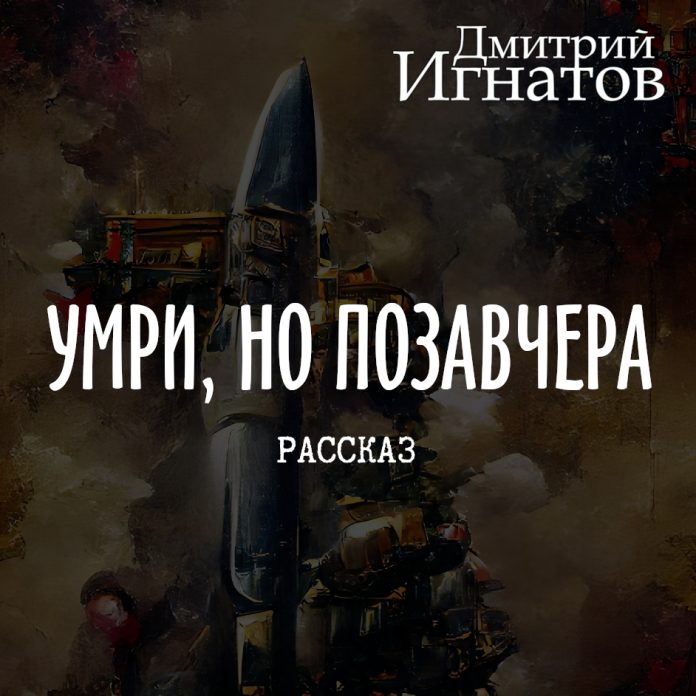
Suddenly, the siren fell silent, and a black mass of the rocket began rising upward from the hatch, as if screwing itself into the clear sky.
“It seems part of the auxiliary chains have burned out,” Sazhin commented.
“Maybe… nothing will happen after all…” Olesya said softly, with a hint of hope in her voice.
“It will work.”
The rocket reached the launch position and froze.
“I’m… a little… scared…”
“You remember how much you love retro things? Well, create a musical moment to mark this farewell to the past.”
“Farewell… to the past…” the girl repeated thoughtfully behind her companion and, pulling off a mitten from her frozen hand, began poking at the smartphone screen with her clumsy fingers. A second later, the words of an old song began playing through its raspy speaker…
Farewell!
From all stations the trains
Depart for distant lands
Farewell!
We’re parting forever
Under the white January sky.
“Do you like it?” the girl asked, her voice trembling, “I made you a musical moment. Now it’s your turn… God of War…”
Sazhin silently set the timer on the tachyon inductor and raised his finger over the control panel.
“Well, just do it already!” the girl shouted, and the scientist pressed the button.
Flames burst out from under the rocket, it shuddered, and with an increasingly loud roar, began slowly ascending.
Farewell!
Amidst the snows in the middle of winter
No one will bring us summer back.
Farewell!
We cannot return it
In the July stars of the heavens.
Finally, the massive object, having gained power and suddenly becoming lighter than a feather, began rapidly rising upward. Sazhin followed it intently with his gaze, waiting for the cherished device in the nose section to activate—their creation with Olesya….
Farewell!
Don’t promise anything.
And don’t say anything.
To understand my sadness
Look into the empty sky.
Already quite high above, the rocket was enveloped in a bluish glow. It suddenly seemed to freeze in place and literally dissolve into thin air, becoming transparent until it completely disappeared. At this moment, if it’s possible to apply the word “now” to this event, it was flying over the Atlantic Ocean while simultaneously traveling three years into the past.
Sazhin closed the terminal cover and glanced at Olesya. She was still staring upward with unblinking eyes, tears welling up, while the chorus continued to play from her smartphone.
Do you remember, was floating in the sky
And suddenly two stars went out.
But only now it becomes clear to me
That it was you and me.
* * *
Sazhin turned off the boat’s engine, and now it moved only slightly by inertia, gently rocking on the smooth surface of a wide, slightly elongated lake stretching between hills. While Pyotr Petrovich rummaged through a box at the stern, Olesya opened a white sun umbrella and settled herself comfortably on the bow, half-lying down. Where she managed to get this umbrella remained a mystery to the scientist, but apparently, her innate aristocraticism, certainly necessary to find the required accessory in any situation, helped her.
Finally, Pyotr Petrovich adjusted the fishing rods and cast them into the water with a quiet splash. There should have been plenty of fish here, because sometimes they literally played in the shallow water, glistening on the surface with their backs, and in the shallows hundreds of fry darted around in the sunlight among the minnows.
Olesya dangled her slender arm into the warm emerald-green water and rested her other hand under her head, preparing to take a short nap. Lately, her belly had become noticeably rounded, and the nausea had finally subsided. The girl was almost closing her eyes when she noticed, on the opposite side of the lake against the backdrop of trees, a pair of white swans gliding across the water and landing.





There are some captivating details within this story.
I’m intrigued by the characters, there are few. But I do like Sazhin the most.
I’m fascinated by the connection and the scenes between Sazhin and Olesya.
I’m highly intrigued by it. Very well written. x
Thank you very much. I’m very happy 🙂