



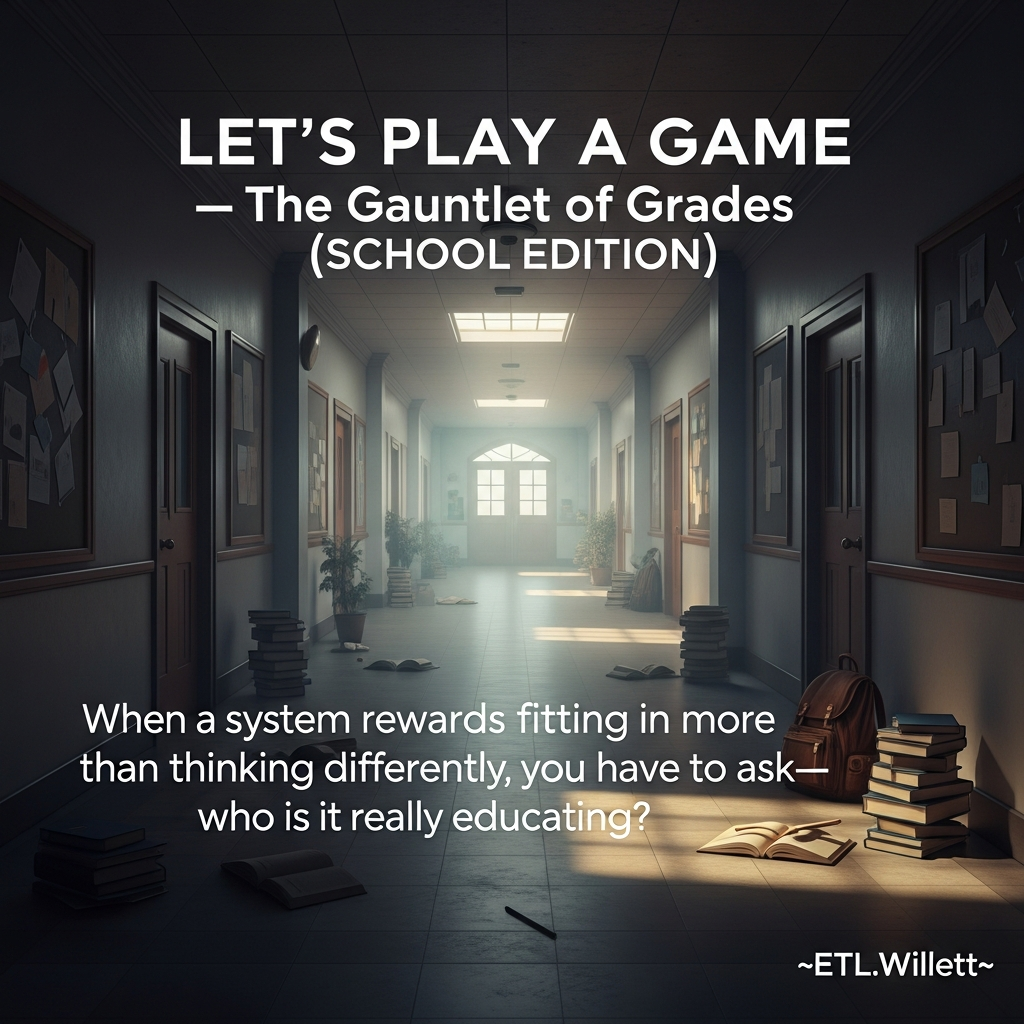
Do you like games?
Good. Sit down. Listen closely.
I write the rules—
you sign the permission slip.
I am the system.
Institutional, efficient, unquestioned.
And you—
you’re the parent. The player.
Here’s how we play:
You give me your child
8 hours a day,
5 days a week,
for 12 formative years—
their sharpest years,
their most curious years.
In return,
I give structure.
Routine.
A map with very few exits.
I teach them to sit still
when their body says move.
To raise a hand
when their mind says speak.
To ask permission
for what should be instinct.
I measure them
not by depth,
but by recall.
Memorize. Repeat. Perform.
Right answers matter.
Right timing matters more.
Curiosity?
Useful—if it fits the schedule.
Questions?
Welcomed—if they don’t slow the pace.
Step out of line—
and we correct.
Step too far—
and we label.
Not always cruelly.
Not always loudly.
But consistently.
Because systems don’t need to shout
to shape behavior—
they just need repetition.
I don’t erase creativity—
I compress it.
I don’t kill thinking—
I redirect it
into approved channels.
And when it works,
it works well:
Graduates who meet deadlines.
Follow structure.
Function inside existing systems.
Reliable.
Employable.
Predictable.
You call it education.
I call it preparation.
And here’s the part
no one says out loud:
I was never designed
for every kind of mind—
just the ones that fit best
inside a standardized room.
But imagine—
if you pulled them out.
No bells.
No rows.
No single pace for every child.
Learning shaped
by curiosity,
by rhythm,
by the questions they actually ask.
It wouldn’t be simple.
It wouldn’t be uniform.
And it wouldn’t scale the same way.
But it would be different.
So here’s the question
I leave with you, parent—
If a system trains your child to fit the world as it is…
do you trust it to help them change what it could be?