



- THE UNANCHORED BOX AND THE VANISHING PICTURES
- A TED BUNDY TRUE STORY ENCOUNTER
(A strange dream I had in real)
Chapter I: The Salt and the Silver
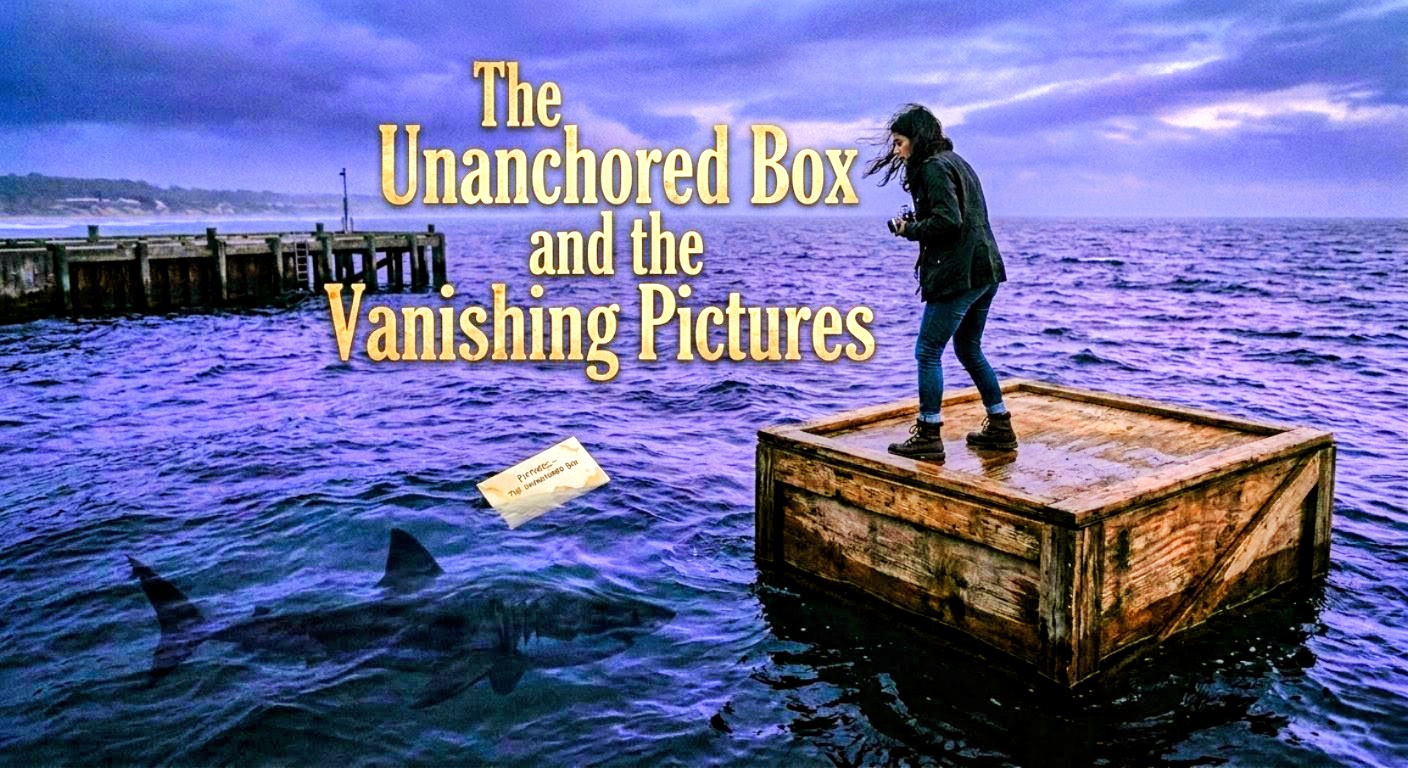
The calendar on the pier piling didn’t make sense. It was a heavy brass plate that read October 44th, Year of the Tide. Navina stood on the lid of the massive wooden crate, her boots clicking against the cedar. The box was the size of a small room, bobbing in the harbor of a place that looked like a memory of a town. The water wasn’t blue; it was the color of a bruised plum, thick and viscous.
”Navina! You’re drifting!” a voice hollered from the dock. It was a man in a heavy wool coat, his face obscured by the shadow of a wide-brimmed hat.
”I know!” she shouted back, her voice sounding thin, like a radio signal losing its frequency. “There are no ropes! Why are there no ropes?”
She looked down at her hands. In her left, she clutched a thick, cream-colored envelope. She could feel the weight of the photographs inside—the “Moth Picture,” with its intricate, dusty wings that seemed to pulse if you looked at them too long, and a dozen other memories she couldn’t afford to lose. In her right hand, she held a small, silver camera. It was cold, mechanical, and entirely empty of film.
The box groaned. A deep, subterranean vibration shook the wood beneath her feet. From the depths of the plum-colored water, a shape began to rise. It wasn’t one shark, but a dozen—monstrous, slate-grey silhouettes circling the box in a perfect, hungry clockwork.
”The pictures, Navina!” the man on the dock cried out. “Don’t let the ink run!”
As if the ocean heard him, a rogue swell slammed into the side of the crate. The world tilted. Navina’s feet skidded across the wet cedar. The envelope—the repository of her entire history—slipped. She watched in a sickening slow-motion as it somersaulted through the air and hit the water with a soft slap.
”No!” she screamed. She dropped to the edge, her fingers inches from the floating paper.
But then, a shark broke the surface. Its eye was a solid marble of obsidian, reflecting her own terrified face. It didn’t snap; it just waited. The message was clear: The water belongs to the forgotten.
She pulled her hand back, trembling. She looked at her other hand. She was still white-knuckling the silver camera. The envelope drifted further away, sinking slowly into the dark purple depths. A hollow, crushing depression settled over her. She had saved the tool to capture life, but she had let the life itself drown.
”I saved the wrong thing,” she whispered to the wind. “I saved the hollow thing.”
Chapter II: The Paper Bridge
The transition didn’t happen with a flash. The salt air simply started to smell like charcoal, and the sound of the waves turned into the rhythmic scritch-scritch of a pen on paper.
Navina was no longer on the water. She was in a high-ceilinged room with windows that looked out onto a void of white mist. In the center of the room stood a man named Elias. He was tall, his fingers stained to the knuckles with black India ink.
”We’re behind schedule,” Elias said without looking up. “The 13th hour is almost over.”
On the far wall, a long, rectangular strip of rice paper was taped up. It was positioned exactly at face level.
”It has to be perfect, Elias,” Navina said, her voice tight with a desperate urgency. “Start under the chin. It needs to reach eight inches above the crown. If the dimensions are off, she won’t be able to see it.”
”See what?” Elias asked, dipping a bamboo brush into a bowl of ink that looked exactly like the water the sharks had lived in.
”The way out,” Navina replied, though she wasn’t sure why she said it.
She turned and walked through a heavy, velvet curtain into an adjoining room. The air here was cold—the kind of cold that starts in the bone marrow. On a narrow bed lay a woman. We will call her Clara. Clara’s skin was the color of a faded photograph, her eyes fixed on the ceiling.
”Is the art ready?” Clara whispered. Her voice was like dry leaves skittering across pavement.
Navina took her hand. It was weightless. “Elias is working on it now. It’s black ink on white paper. Simple. Striking. You just have to hold on, Clara.”
”I’m trying,” Clara said. “But the dock is getting so far away, Navina. I can hear the sharks.”
Navina felt a jolt of electricity run through her. The sharks. The two worlds were bleeding into each other. She ran back to the studio.
”Faster, Elias! Use more ink!”
”If I use more, it will bleed through the paper!” he argued.
”Let it bleed!” Navina shouted. “The clock is backward!”
She looked at the wall. The clock’s hands were spinning wildly in reverse. It was June 82nd one moment and May -10th the next.
Chapter III: The Mirror in the Ink
Navina hurried back and forth—a frantic messenger between the dying woman and the rising art. Every time she entered the sickroom, Clara looked more transparent. Every time she returned to the studio, the black ink on the rice paper looked more like a silhouette of a person.
”It’s done,” Elias finally said, dropping his brush.
The art was a haunting, minimalist figure in black ink. It was positioned so that when Navina stood in front of it, the ink “chin” lined up with her own, and the “crown” reached exactly eight inches above her head. It wasn’t a portrait; it was a doorway.
Navina ran to the sickroom. “Clara! It’s ready! Come look!”
But the bed was empty. The sheets were cold.
A panicked sob rose in Navina’s throat. She turned back to the studio, but Elias was gone too. The silver camera she had saved from the ocean was sitting on the floor in the center of the room.
She picked it up. She felt a strange compulsion to look through the viewfinder. She aimed it at the rice paper art—the black ink silhouette.
As she adjusted the focus, the white background of the paper began to move. It wasn’t paper anymore. Through the lens of the camera, she saw the plum-colored ocean. She saw the massive wooden crate drifting in the distance.
And there, standing on the dock, was the woman from the bed. Clara. She was holding the cream-colored envelope—the one Navina thought she had lost to the sharks.
Clara looked directly into the camera lens, spanning the distance between the two rooms, the two worlds. She smiled, a sad, knowing expression.
Navina looked down at the camera. There was no film, yet the “shutter” clicked on its own.
The Cliffhanger
Navina pulled her eye away from the viewfinder. The room was silent. The rice paper on the wall was now completely blank. The ink had vanished.
She looked down at the camera. On the back, where there should have been a digital screen or a film door, there was a small, glowing slot.
A single photograph began to slide out.
Navina’s heart hammered against her ribs. She took the edge of the photo and pulled it. As the image emerged, her breath hitched.
It wasn’t a picture of the art. It wasn’t a picture of Clara.
It was a picture of Navina herself, standing on the pier, holding a silver camera, looking at a massive wooden box in the water. But in the photo, she was the one who was transparent. She was the one fading away.
And at the bottom of the photo, in her own handwriting, were the words:
“Don’t worry about the pictures. I’m coming back for the camera.”
Suddenly, the sound of a heavy wooden lid slamming shut echoed through the room, and the floor beneath her feet began to tilt, smelling once again of salt and old cedar.