


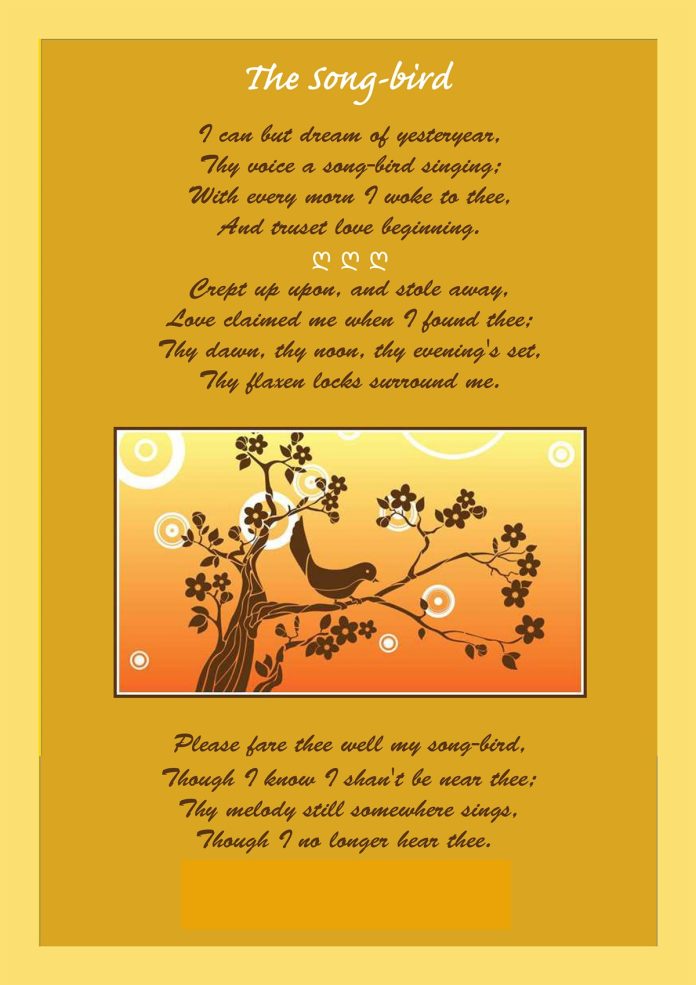
Before the house had learned its sorrow,
before the clock grew fat with silence
and the chairs began to keep their counsel,
there was a bird whose throat
could unlock the morning.
She came not like a guest,
but like a blessing that had forgotten itself,
perching at the edge of day
with her bright, impossible music.
And I, who had wandered long
through the cold provinces of the heart,
heard her once and knew…
not with reason, but with the ancient blood…
that some voices are not merely heard,
but entered,
as one enters a grand cathedral of light.
I can but dream of yesteryear,
when her singing was a lamp in the window,
when each dawn climbed softly over the sill
as though it had been invited.
Her voice was not a thing alone.
It was bread for the hungry hour.
It was rain finding the dry root.
It was the silver fish of laughter
turning in the dark river of a room.
With every morn I woke to thee,
and the day, which had once been only a task,
became a kingdom in which even sorrow
stood still and listened.
The walls themselves were altered by her music.
The cups grew warmer.
The bread remembered the wheat it came from.
Even the dust upon the stair
seemed less a burden
than a small, shining kingdom of the fallen.
And love, that old thief,
crept up upon us in plain garments.
It entered by the back gate,
by the soft hand of habit,
by the little customs of living…
a glance, a shared cup,
the brush of a sleeve,
the certainty of being understood
without needing to speak too loudly.
I did not know I was becoming hers
until my days were already leaning toward her
like sunflowers toward the west.
She had flaxen hair, yes…
a pale and living fire,
the colour of late straw under summer light,
the colour of wheat that has survived the storm,
the colour of dawn laid gently
upon the shoulders of a woman
who sang as though her soul
were a window left open to heaven.
Thy flaxen locks surround me.
Even now they do,
in the mind where grief keeps its faithful altars,
in the chamber where memory
still lays out its small bright offerings.
Then came the wandering dark.
It was no wolf, though it had the hunger of one.
It was no witch, though it knew old names.
It came as all endings come…
without ceremony,
with a hand already on the latch.
And the bird, who had made a country
of every room she entered,
was taken from the air of us.
The house did not break all at once.
It was slower than that.
A chair waited where no one would sit.
A window opened to morning
and found the morning less merciful than before.
The kettle sang in the kitchen
and was suddenly ashamed of itself.
Even the mirrors grew practical,
offering back only the skin of the world.
I searched for her voice in the places
where voice is known to hide:
in the seams of curtains,
in the throat of a string section,
in the dark hollow beneath a stair,
in the warm dust of old records,
in the fold of a hymn forgotten by the congregation.
But grief is a stern country.
It does not return what it takes.
It only teaches the hand
how to hold absence
without dropping it.
Please fare thee well, my song-bird,
I said to the sky,
to the branches,
to the lamp that burned alone in the evening,
to the silence that had learned her shape.
Though I know I shan’t be near thee,
I did not mean it as surrender.
I meant it as the weak, brave speech
of one who loves beyond the measure of his breath.
For if I could not keep her body,
then let me keep the kingdom she made.
Let me keep the first note of her laughter
caught in the rafters.
Let me keep the tenderness
with which she entered a room
as one enters spring
without insulting winter.
Thy melody still somewhere sings,
I told myself,
and because the heart is a foolish and holy animal,
I believed it. I believe it still…
Somewhere, beyond the last fence of sorrow,
beyond the hill where names become wind,
she is singing into a morning and a mourning
too wide for grief to own.
Somewhere the birds of all the world
turn their heads and listen,
as if they have just remembered
what the dawn was made for.
And now I know this:
A voice may leave the room
and not leave the world.
A beloved may vanish
and still instruct the seasons.
A singer may pass beyond our reach
and yet remain the hidden music
inside the branch,
inside the river,
inside the chest of the one who loved her.
So I walk through the years as one
who has been marked by a song.
I carry it in the sleeve of my mourning.
I carry it in the bread I break.
I carry it in the hour before sunrise
when the house is paling
and memory, like a child,
climbs quietly into the bed beside me.
And when at last my own voice fails,
let it fail listening.
Let it fail facing the east,
Towards the country that became
my own not by birth but by blood.
Let it fail with gratitude.
For I was once loved by a song-bird,
and what is grief, after all,
but love that has learned to sing
without being answered?





Favorite Stanza “Her voice was not a thing alone. It was bread for the hungry hour.”
“And love, that old thief,
crept up upon us in plain garments.
It entered by the back gate,
by the soft hand of habit,
by the little customs of living…
a glance, a shared cup,
the brush of a sleeve,
the certainty of being understood
without needing to speak too loudly.”
So many good parts. Thoroughly enjoyed this
Oh, thank you! I wrote the short form poem in the graphic many years ago about the same person, and this longer one after I came across the earlier one after not reading it for a very long time. I’m so glad you liked it!
Monetize your traffic instantly—enroll in our affiliate network!