


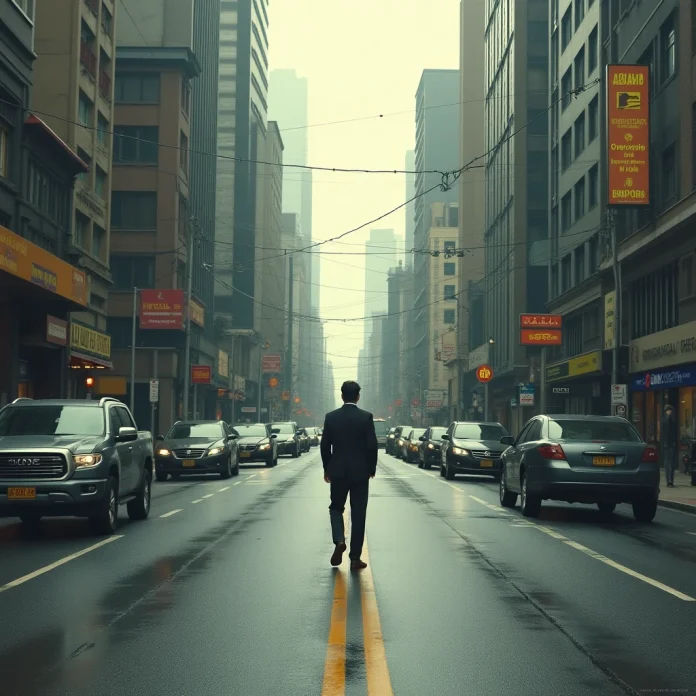
The city awakens with a light that shouldn’t exist.
It’s not dawn, it’s not a reflection,
it’s a green-orange radiance that trickles down the facades
as if someone had opened a fissure in the sky.
Paul walks down the street
with the feeling that the ground has lost its memory.
The sidewalks are slightly displaced,
as if they had been pushed by a subterranean animal.
The absent ants have stopped
their gatherings
and this absence creates a mineral silence,
a silence that seems to observe.
On the electrical wires, the swallows that remain line up
like characters of an ancient language.
They don’t migrate: they watch.
Each one is a glyph, a warning,
a fragment of prophecy.
When Paul passes, they incline their heads,
not like birds, but like priests.
The traffic light hesitates between green and orange.
The hybrid light comes on
and Paulo feels his body being summoned.
It’s not to move forward, it’s not to stop: it’s to enter the ritual.
He crosses the street and realizes
that the city has changed its texture.
The shop windows reflect not objects, but metamorphoses;
the buses seem to breathe;
the neon signs flash messages
that no one can decipher.
The green-orange color settles on the windows
like a fever that wants to be read.
Paulo follows this color to a square
where everything seems suspended.
People move slowly,
as if they were learning a new choreography.
In the center, a fountain spouts water with a vegetal-incandescent hue.
The water doesn’t fall: it levitates for moments,
as if it were deciding whether it wants to be liquid or flame.
That’s where the ritual reveals itself:
The city is not being observed by love, it is trying to love.
And it fails. And it insists. And it hesitates. And he repeats.
Paulo realizes that green-orange isn’t a color, it’s a state.
It’s the interval between two worlds,
the zone where instinct loses the map
and permanence becomes possible.
He reaches out to the suspended water
and when he touches it, the city breathes deeply,
as if it had been waiting for this gesture.
The ritual concludes not with an epiphany,
but with a minimal alteration: the ground returns to its place,
the swallows blink, the traffic light finally chooses a color.
But Paulo knows that something remained.
Something unseen,
but which reorganizes the way the city looks at him.
Love, there, became infrastructure.


Powerfully penned, PAR. Another excellent write with brilliant storytelling and vibrant imagery my friend. There is always so much depth in your work brother. Amazing read as always. Appreciate you.
Damian
Appreciate you.
Tight! I love the descriptive elements that create the landscape of this scenerio. And the deep-thoughts travel well along the path of Paul, through your lines. Awesome pace and introspection.
Thank you my dear friend.