


If you have enough land, try to plant the crops instead
of raising garden.
Reliance industry did the same thing,
for green plantation to control the pollution
of poisonous gases he planted Mango tree plantation
I have other ideas,
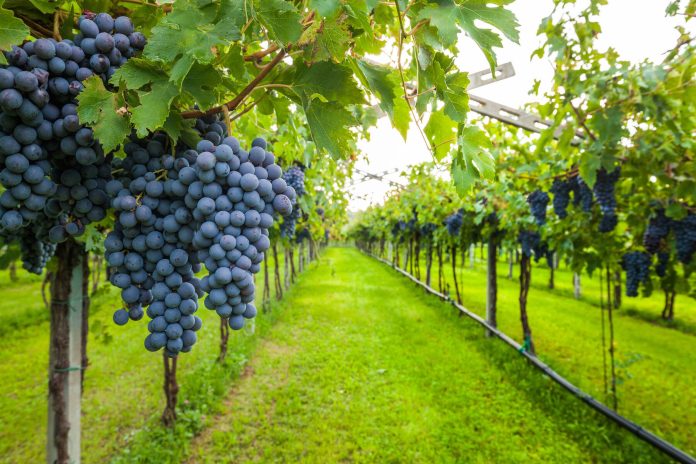
grow crops suitable for weather, such as grapes,
cash crops, and grains.
When you have grape yards, you can built
beer factory and produce wine.
Potatoes to chips make
Apples Oanges strawberries and other fruits to breweries juices make
We can use the wide area for solar panels.
A mixed crops and solar energy can be revenue generation
instead of just gardening.
Flowers also make good business.
This will be a side income and also solve the problems.
Think about this idea.
I have a small balcony,
I tried growing the microgreens, flowers, leafy vegetables and some other plants for health
My only point I say is there is nothing srap that can be thrown,
you can see with presence of mind you will see value in each thing.
So dont spend lavishly the life,
make use of what you have and grow rich.
Grape plant
- 1 Single Vine: Takes about 10 square feet of space and produces enough grapes for 3 bottles of wine.
- Backyard / Hobby (0.22 Acres): Planting about 200 vines on a small plot yields roughly 680 bottles (56 cases).
- 1 Full Acre: Contains 1,400 to 2,400 vines and produces an average of 3 to 4 tons of grapes, creating about 3,120 bottles (260 cases).
- Commercial Business Minimum (5+ Acres): Experts suggest a minimum of 5 acres if selling direct-to-consumer, or 10+ acres if selling wholesale, to cover high operational costs and achieve profit
- Yield vs. Quality: High-end winemakers limit fruit production to 2 tons per acre for stronger flavor concentration, which lowers total bottle output per acre. [1]
- Time Investment: Vines take 3 years to bear usable fruit after planting, and commercial vineyards often need 5 years to turn a profit. [1]
You can grow grapes on very small land, even less than 1 acre, but the economics change significantly with scale.
🍇 Land requirement by purpose
| Purpose | Land needed | Comment |
|---|---|---|
| Home/experimental vineyard | 0.1–0.25 acre | Good for learning |
| Small commercial vineyard | 0.5–1 acre | Possible, but costs per acre can be high |
| Serious small business | 2–5 acres | Better scale for equipment/labour |
| Commercial vineyard | 5–10+ acres | Better for consistent supply |
| Processing/export-oriented | 20+ acres | Usually needs aggregation/contract farming |
For your 1 acre
Yes, 1 acre is enough to establish a commercial grape vineyard, provided your land, water, climate and market are suitable.
But grapes are very different from the vegetables we discussed earlier.
You generally have to invest heavily before meaningful commercial harvest:
Land preparation → trellis system → planting → training/pruning → irrigation → crop protection → first harvest
So I would not use your entire 1 acre for grapes immediately if your objective is year-round income.
A more conservative approach could be:
0.5 acre grapes
-
0.5 acre short-duration vegetables
Then you get:
🍇 Grape income developing over the longer term
🥬 vegetable income during the establishment period
Important for Telangana
Grapes need careful consideration of variety, temperature, rainfall, soil drainage, irrigation water quality and market access. Telangana can grow grapes, but not every location is equally suitable.
If you tell me your district and whether you have borewell irrigation, I can calculate for 1 acre of grapes:
-
number of vines
-
suitable varieties
-
trellis cost
-
drip cost
-
planting cost
-
yearly maintenance
-
first harvest timing
-
expected yield
-
conservative/medium/high revenue
-
and whether grapes or your earlier vegetable plan is likely to give you better returns.
Yes. For your 1 acre, I’d evaluate grapes as a long-term investment rather than assume they will automatically be more profitable than vegetables.
🍇 1-acre grape vineyard — rough plan
A commercial vineyard typically uses a substantial trellis/support structure. The exact plant population depends on the training system, variety, soil and local recommendations.
A useful planning range is roughly 1,000–1,600 vines per acre.
Approximate establishment budget
| Item | Approx. ₹ |
|---|---|
| Land preparation & pits | 20,000–40,000 |
| Grape plants | 20,000–50,000 |
| Drip irrigation | 40,000–70,000 |
| Trellis/support structure | ₹1.5–3.0 lakh |
| Fertilizers/manure | 25,000–50,000 |
| Crop-protection inputs | 30,000–60,000 |
| Labour/training/pruning | 40,000–70,000 |
| Miscellaneous | 25,000–40,000 |
| Approx. establishment/first-year outlay | ₹3.5–6.8 lakh |
These are planning ranges, not quotations. The trellis system is one of the biggest variables.
⏳ Don’t expect immediate income
This is the major difference from your vegetables.
Year 1
Mostly establishment and vine training.
Year 2
Possible early commercial production depending on variety/training and local practice.
Year 3 onward
You can aim for a properly established production system.
A well-managed vineyard can remain productive for many years, but returns depend heavily on variety, crop load, disease management, pruning and market price.
🍇 Possible production
For planning purposes, don’t build your financial model around the highest yield.
Suppose eventually you achieve:
8–12 tonnes/acre
and your average realized price is:
₹40/kg
Then:
8,000 kg × ₹40 = ₹3.2 lakh gross
At:
12,000 kg × ₹40 = ₹4.8 lakh gross
If you obtain ₹60/kg:
10,000 kg × ₹60 = ₹6 lakh gross
These are illustrative scenarios, not predictions. Grape prices can vary dramatically depending on variety, quality, season, buyer and whether you sell through wholesale, traders or direct channels.
💰 The real opportunity is not just growing grapes
This is where I think your 1 acre could become interesting.
Instead of:
Grow → sell to trader
you could eventually develop:
Grade A
Fresh table grapes → premium/direct buyers
Grade B
Local retail/wholesale
Lower-grade fruit
Juice/processing
Pruning material
Potential compost/other permitted agricultural uses
You’re trying to use more of what you produce.
🍇 Which grape type?
For a small farmer, I would first investigate table grapes, rather than wine grapes, unless you already have a confirmed winery/buyer.
Common Indian commercial table-grape varieties include:
-
Thompson Seedless
-
Sonaka
-
Sharad Seedless
-
Manik Chaman
-
Other locally recommended seedless varieties
But don’t select a variety from a generic internet list.
Talk to the local horticulture department/agricultural university and nearby successful grape growers first.
The variety has to match your exact local climate and market.
⚠️ One major issue: Telangana climate
Grapes are sensitive to:
-
Rain during critical stages
-
Humidity
-
Fungal diseases
-
Waterlogging
-
High temperatures
-
Poor-quality irrigation water
-
Incorrect pruning timing
So the question isn’t simply:
“Can grapes grow in Telangana?”
It’s:
“Can this particular location produce commercially good grapes at the right time for a profitable market?”
That’s a much better question.
🌱 What I would do with your 1 acre
I would not immediately convert all 1 acre.
I’d consider:
Option A — Conservative
0.25 acre grapes
0.75 acre vegetables
Learn grape cultivation for one cycle.
Option B — Balanced
0.5 acre grapes
0.5 acre vegetables
This gives you long-term vineyard development while keeping annual cash flow.
Option C — Vineyard-focused
1 acre grapes
Only after confirming:
✅ Suitable soil
✅ Good-quality irrigation water
✅ Local grape-growing success
✅ Reliable labour
✅ Market/buyer
✅ Disease-management capability
✅ Capital for trellis + irrigation
⭐ My recommendation for you
Since you originally asked about year-round crops and income, I’d choose Option B if you’re new to grapes:
0.5 acre grapes
Long-term asset.
0.5 acre vegetables
Short-term cash flow.
Then after 2 years, you can decide whether to convert the remaining land to grapes based on your actual results.
And if you have access to more land later, grapes become considerably more interesting because your fixed costs—equipment, technical knowledge, labour arrangements and marketing—can be spread over a larger area.
If you tell me your exact district in Telangana and whether your 1 acre has borewell/canal water, I can make a much more useful grape-vs-vegetable comparison for your land, including a 5-year cash-flow model.
Jessy Jacob.