

6:42 a.m. Ringing silence. I find myself walking through the ruins of the hospital’s first floor. The recreation area above has been completely destroyed by the explosion. Concrete slabs are crumbled and covered in soot, with bent rebar sticking out of them like ribs. A ZIL truck that fell from the destroyed staircase is burning out. Around it are dozens of mangled bodies: parts of arms and legs, intestines torn from stomachs, just shapeless pieces of meat…
In the general chaos, I suddenly recognize a familiar face. It is a gypsy boy. His eyes are calmly closed, and his black hair is tousled as usual, as if he were simply asleep. I reach out my hands and, lifting his head from the ground, instinctively press it against me. Where everything else is, it is no longer possible to understand.
I continue walking, not knowing where. Stumbling over someone’s remains. Gently hugging the boy’s severed head. Something inside me is feverishly trying to stabilize my mental state, pumping new and new portions of active substances into my blood.
Why all is happening? How meaningless it all is… The bodies of Hungarian soldiers lie next to an armored personnel carrier torn apart by a rocket. They lie on the ground and hang from charred armor like torn rag dolls. Nearby are the Americans they shot. Did they know yesterday that today they would be together forever? How can this be assessed through Sartre’s existentialism? An act of human free will that brings meaning to the existence of the surrounding world? What a stupid decision.
“What are you doing?!” Jean-Pierre, who appeared from nowhere, shouts at me through some kind of buzzing, muffled veil.
He grabs me and drags me closer to the ruined hospital walls, hurriedly saying something about soldiers who have disembarked from several more trucks. Another horse dose of adrenaline is released into my bloodstream and gradually clears my mind. We hide and lie low behind a pile of collapsed concrete slabs. I carefully lay the boy’s head on a broken beam and gently cover it with a dusty rag. We’ll come back for you someday, kid.
I hear movement nearby. The shuffling footsteps of military boots on broken bricks. Judging by the sound, there are two of them. That’s right. Two infantrymen are circling the site of yesterday’s massacre, looking for anything they can loot. Jean-Pierre, his back pressed against the wall and clutching his MP-5 tightly, seems ready to wait until the Americans disappear around the corner. But I don’t want to miss such easy prey.
As if obeying some kind of pre-programmed instinct, I run up and push both of them in the back, knocking them to the ground and landing on top of them. Without a second’s hesitation, I gouge out the first one’s eyes with my fingers, then snatch his combat knife from his belt and slit the second one’s throat with one deep cut. The blinded soldier screams in agony, but I ignore him and calmly take a couple of M-16s from them. New meat will soon arrive here, which means I need to prepare. Together with a shocked Jean-Pierre, I quickly enter the building.
Inside, the hospital looks sinister. Wards, offices, and corridors littered with broken furniture, dirty rags, and broken glass inspire gloom. The posters remaining on the walls vividly describe the benefits of vaccinations and early diagnosis in a language unknown to me. The Frenchman nervously waves a flashlight around, which is a little annoying. I look around, figuring out how the building could be used to destroy small groups of enemy forces.
“Vera, look!” the journalist calls to me, sounding as if he has discovered something strange.
One of the staircases leading down to the basement is, for some reason, completely blocked by a reinforced metal door with a mechanical combination lock.
“Maybe it’s a bomb shelter or an arsenal?” the Frenchman suggests, offering some unlikely theories.
“More likely a morgue,” I reply. “Shall we try to get in?”
I don’t know why, but I enter the combination 6-4-2 and the lock gives way.
“How did you guess?”
“I don’t know. Let’s go.”
We descend the stairs into darkness. Now I turn on my flashlight too. The putrid smell of corpses hits my nose. It really is a morgue. On the left and right sides of the long, narrow room are cells in which, obviously, rotten corpses have been lying for years without refrigeration.
Driven more by his unhealthy reporter’s curiosity than by logic, Jean-Pierre pulls out one of the boxes and immediately covers his nose with a handkerchief. The last thing he needs is to throw up and then faint in his own vomit. But the Frenchman holds on.
On a metal tray lie two small, almost decayed corpses. They are twin girls, about 8 or 10 years old. Their rotting bodies bear traces of numerous surgical incisions. Many are stitched up and healed, which means they were operated on repeatedly and successfully.
“The old woman said she saw twins here…” mutters Jean-Pierre. “What kind of Dr. Mengele was experimenting here?”
Pushing the Frenchman’s shoulder, I hint that we need to go. We pass through the foul-smelling gut of the morgue and come up against another metal door with a combination lock. It would be foolish to try our luck a second time, but without thinking, I enter another combination of numbers that somehow popped into my head. 2-3-1. There is a metallic click, and the lock opens.
“Coincidence? I don’t think so,” the journalist tries to joke.
The door leads us into a spacious corridor connecting several separate rooms. It must be some kind of secret laboratory. A couple of operating rooms, offices with medical equipment, cabinets for storing documents. It seems that, relying on the armored doors, the owners of these goods were not particularly concerned about the need to remove or destroy them. Or perhaps they simply did not have time to do so for some reason.
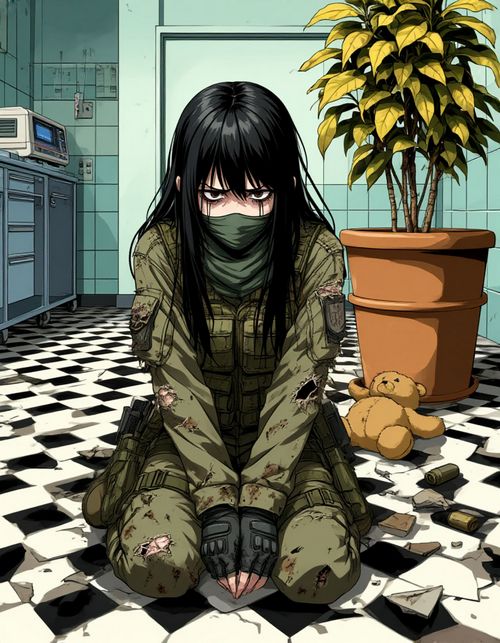
Forgetting his nausea, the journalist pounces on the documents with a predatory gleam in his eyes. I slowly walk further down the corridor. The black and white checkered tile floor seems familiar to me. On the right, in a large tub, is a dried-up ficus tree. I remember when it was growing and producing green leaves. The fluorescent lights on the ceiling were enough for it. A little further on, there is an evacuation plan on the wall. It is still there. Among the symbols on it was a circle in which… I once drew a smiling face. There it is.
I stop at a wooden door with a brass handle and, after pausing for a couple of seconds, open it. This living room is very different from all the other rooms. The walls are covered with beige wallpaper that has peeled off over time, with a pattern of green leaves and golden petals. There is a wardrobe, a bed, a small desk with a bouquet of colored pencils still standing in a glass. I remember drawing two girls with pigtails holding hands as a child and signing it “Me and my sister.”
In the darkness, I kick something soft with my foot and pick up a teddy bear from the floor. The light from my flashlight suddenly hits my eyes, reflecting off the mirror. For a moment, it seems to me that there is a little girl standing in front of me, clutching her toy in her hands. But it’s just me. And this is just my room.
“Jean-Pierre!” I say to my companion without turning around, “I suddenly realized that we came here for nothing. I never had parents. And I never had a sister. Other children had twin brothers and sisters. They walked together on the street… And held hands… It was so nice. But I didn’t. And I always envied them. I dreamed that I could have a twin sister too… And, imagining her, I would stare into this mirror for hours.
“I think… They should have envied you,” replies the Frenchman from his office, without stopping leafing through thick folders of documents. “They were all guinea pigs… Objects for testing tissue transplantation and engraftment technology… Consumables. Unlike you… And your sister.
I go back, approach Jean-Pierre, and look at him:
“I remember everything,” I repeat calmly, “There was no sister.”
“There was,” the journalist looks up at me, “but of course you can’t remember her. She lived as a separate organism for only a couple of weeks. Then the embryos underwent a special series of procedures, after which one was absorbed by the other and they developed as a single organism.”
“Like a matryoshka doll?”
“Almost…” The Frenchman slaps a thick folder on the table. “The scientists recorded the entire process here. The inner twin did not develop as a human being. Its DNA was significantly damaged by chemical mutagens, and the external environment did not require it to develop a skeleton, a fully functioning brain, or its own heart… Your sister became part of your body, something like an artificial gland connected to your body and controlling it…
“Are you saying that my sister…?” .
“It’s a tumor.”
“Hey…”
“Or a parasite.”
“Man, you’re talking about my sister!”
“That’s how they define her… ‘Sintezoma — a synthetic symbiotic tumor-like organism,’ perfectly adapted to its host and providing it with everything it needs. It can produce a whole range of hormones, neurotransmitters, stimulants, and other biologically active substances for you: it can speed up your metabolism and tissue regeneration, help relieve pain and fight infections… It turns you into the perfect predator-host, providing the Sintezoma with protection and nutrition.
Something inside me seems to hear what we are talking about. A dose of endorphins enters my bloodstream and makes me smile involuntarily.
“Well, then… I guess your investigation can be considered a success,” I say, not yet fully realizing the significance of the information I’ve received and its implications. “I really am an ‘unusual girl with an unusual history.’ Literally one of a kind…”
“Not quite…” replies Jean-Pierre, struggling to stuff thick folders into his bag. “According to the records, the procedure was successfully performed at least 15 times… The children were distributed among various shelters and orphanages in the republics of the USSR and the socialist countries. There’s a list… So this is just the beginning. We need to…”
The journalist stops short and freezes when he hears a noise. A metal door clangs above. Muffled English speech and the cautious footsteps of at least four people can be heard. I feel something tighten inside me, raising my adrenaline level and increasing the flow of blood to my muscles.
“Don’t worry, sis. I’ll handle it. Like always,” I mumble, reloading my M4 and taking a step toward the door.
“Vera…” Jean-Pierre pronounces my name with the correct accent for the first time and takes his MP-5 off safety. “There are a lot of them, and they all have weapons…”
“I am… the weapon.”