


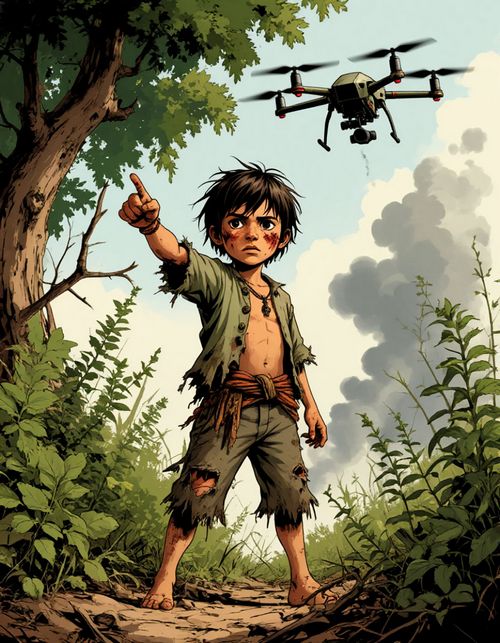
6:42 a.m. I open my eyes. Jean-Pierre is already sitting on his mattress, dressed in camouflage and a bulletproof vest. It seems he couldn’t sleep last night. I slowly put on my boots and lace them up. Then I check my rifle again. All this time, the Frenchman is staring at me intently, as if waiting for a command.
Suddenly, there are shouts from the street. We cautiously approach the window. On both sides of the square, we see a crowd of people. In the middle is a rusty pickup truck, which looks like a badly dented Ford, and the Niva we already know. Masked Hungarian fighters pull three badly beaten people out of the back of the pickup truck. Two men, one of which is clearly European, and one woman, probably a girl, no more than 20 years old. Their faces are covered in bruises. Their hands are tied behind their backs with plastic ties, the kind usually used to bundle equipment.
The captives are lined up on their knees. Mockingbird emerges from the Niva, wearing mirrored sunglasses and a beret that hides most of his light curly hair. The crowd around him falls silent.
Harper announces loudly and with some kind of feigned pathos something like: “Traitors who spied for the imperialist mercenaries of NATO cannot deserve mercy, and in the name of the New Great Yugoslavia, they will be executed immediately.” He then pulls out a pistol and shoots the European man in the back of the head. The fighters nearby fire a short burst from their AKs into the backs of all three men. The bullet-riddled corpses fall to the ground to the approving shouts of the crowd.
The bloody spectacle is over. Harper gets back into the Niva and drives away. The crowd disperses to go about their business. The fighters carelessly throw the corpses back into the Ford’s cargo bed and follow their commander.
“What are they doing here?” Jean-Pierre says, still looking out the window at the empty square.
“It’s none of our business.”
A gypsy boy knocks on our door and peeks in cautiously. It’s time for us to leave.
Armed to the teeth, we follow our little guide through the back streets to the outskirts of town, cross a dirty road, and venture deeper into the forest along a narrow, barely visible path.
Amidst the greenery of the trees, everything seems calm and even peaceful. But I know that this is a deceptive impression. Several times I remind my frog-lover to follow me closely. Although the boy clearly knows the route well, it is possible that new tripwires may appear here from time to time. And the further we go, the greater the chances of this happening.
Finally, we come to a small hill. The boy gestures to us and ducks behind some tall bushes. We follow him. Just below our position, there is a road running down the slope. A second later, it becomes clear what has alarmed our little tracker. A convoy of vehicles appears from around the bend in a cloud of dust. Five covered trucks with NATO identification marks. In one of the vehicles, I manage to make out several helmets, which means that the Americans are transporting not only cargo but also soldiers. It could be an unpleasant encounter.
As soon as the vehicles disappear around the bend, the boy jumps up and, gesturing to us again, nimbly crosses the road, his heels flashing. We follow him. The road goes through the forest again, but it gradually becomes sparser. Our guide begins to get noticeably nervous. At one point, he freezes in place, then crouches down and points to something in the grass.
“A mine,” I say to Jean-Pierre. “We’ve entered a minefield.”
The Frenchman remains silent, literally pressing himself against my back.
We cross a few more similar hills and, finding a safe place, stop for a rest. Jean-Pierre takes a small chocolate bar out of his pocket and gives it to the boy. Where did he get it?
A pair of fighter planes fly quite low above our heads with a wild roar. It seems that even the treetops begin to tremble alarmingly from their flight. Of course, I don’t have time to see what kind of planes they are, but it’s obvious that they are American again. Only their air force operates here. The Integralists only have old Soviet-style helicopters and outdated air defense systems, which still manage to shoot someone down from time to time.
Continuing along narrow paths and avoiding roads, we finally reach our destination by evening. This town was once much larger than the one where we stopped, but the war did not spare it. Most of the houses are almost completely destroyed. There are no signs of life.
“Does anyone live here?” Jean-Pierre asks a boy.
“They’re hiding,” he replies curtly.
As we cross the ruins in search of the address found by my shrewd journalist, I notice cautious movement several times among the broken windows. I feel that dozens, maybe hundreds of eyes are secretly watching us. Something inside gives me confidence, preventing me from being afraid of these glances. I know these people are not dangerous. They are frightened because the war has driven them into their holes, forcing them to hide like rats.
Several times, NATO drones cross the sky above us, forcing us to take cover in the entranceways, which have been torn apart by explosions. What are they looking for here? It’s suspicious. Soon we find ourselves at the address Jean-Pierre found. It doesn’t look like a residential building. It’s some kind of large complex consisting of several buildings with arches and bridges. It looks more like a hospital, if you can even tell what was here now.
We climb a wide, gentle outdoor staircase and find ourselves in a spacious recreation area on the second floor. Once upon a time, there were large floor-to-ceiling windows here, which obviously lit up the entire floor. Now they are just large, lonely rectangular openings leading from the street into the building.
Inside, in the wide corridors and halls, we find people. Lots of people. Old people, women, children, many wounded… They huddle against the walls when they see us. Rags, food packaging, and empty bottles are scattered across the floor. They have obviously been hiding here for weeks.
Jean-Pierre takes a piece of paper out of his pocket with the name of a woman he found in the phone book. He asks who might know her. But no one answers. A bearded man with a bandaged arm, sitting in the corner, suddenly responds to his question:
“What do you care about her?”
“I’m a journalist. I called her…”
“In that case, you’re too late. The old woman died last week. I buried her myself,” the man replies grimly.
Jean-Pierre looks at me in confusion. I shrug. Coming here with such an unreliable lead was indeed the height of naivety.
Suddenly, people come to life, starting to hide in the depths of the corridors. We turn around. Two trucks drive into the square in front of the hospital. They appear to be part of the convoy we saw earlier. Soldiers in NATO uniforms pour out of the vehicles. They don’t have time to spread out before coming under mortar fire. A camouflaged firing point belonging to the Integralists is located between the hospital buildings. One of the trucks instantly catches fire and explodes. The surviving soldiers scatter. A sniper starts firing at them from somewhere on the roof. It seems that drone reconnaissance did not help the Americans avoid the ambush. Not understanding where the fire is coming from, they open indiscriminate fire on the hospital building.
Several bullets hit the wall next to where we are. Someone from the civilians behind us is killed. I press Jean-Pierre down onto the concrete floor with my whole body so that he doesn’t even think about moving. The gypsy boy doesn’t need to be taught this; he crouches behind a cracked column like an Afghan snake.
The sniper on the roof finishes shooting and seems to be changing position. The NATO troops regroup and advance toward the hospital in groups of three or four, nervously keeping their sights on the black windows and openings. People’s nerves are frayed. Several people decide to run across the recreation area to the neighboring corridor. Reacting instantly to the movement, the soldiers open fire on them.
“God, they’re killing people!” the Frenchman below me screams hysterically.
“Shut up!” I growl at him, mentally begging the sniper to return, but he still doesn’t show up. Could they have taken him out after all?
The soldiers are now no more than ten steps away from us. A little more and we’ll be dead, especially in these uniforms. I count to five in my head, then open fire. The first two NATO soldiers are hit right in the face, their brains spilling out. The third, wounded in the neck, manages to fall behind one of the columns. There is commotion behind us again as people try to hide from the shots. I drag Jean-Pierre behind the column, watching to see if the wounded American will come out. But he is no longer capable of fighting. Instead, his friends from the street open fire again blindly at the black windows.
On the other side, knocking down the steel fence, a BTR-70 and a homemade armored ZIL rush into the courtyard. A tank machine gun begins to thump dully from the tower behind the Americans. They, in turn, stop firing at the hospital and retreat into the passage between the buildings. Finally, we can straighten up. The ZIL, turning sharply on the spot, drives its rear end up the stairs and straight into the recreation room. Two Hungarian soldiers jump out of the back.
“Women and children first!” one of them shouts. People rush toward the truck that will save them. I grab the young guide and push him into the crowd with the others. In the panic, a man tries to squeeze in with the women and is shot in the head without warning. The commotion quickly subsides.
Seeing and recognizing us, the soldier makes a welcoming gesture:
“Wanna taken?”
“Yes, we’re leaving,” I nod.
Some sixth sense makes me look up. Two attack drones that had been hovering over the city fly toward the hospital. Realizing what is about to happen, I roll to the edge of the recreation area without hesitation, knocking the Frenchman off his feet and dragging him with me. Slowing down slightly on the steps, I fall to the first floor. Jean-Pierre falls on top of me, seemingly breaking a couple of my ribs.
The first rocket tears open the belly of the BTR, hiding it behind a flash of fire. The second one goes under the bottom of the ZIL and tosses it up slightly. The other two go straight into the darkness of the recreation area, detonating somewhere in the black corridors and turning the entire second floor into a burning hell.
Holding Jean-Pierre close with my arm, I close my eyes. Concrete chips fall from above. Consciousness gradually leaves me. Someone calls my name. In front of me is a little girl in a light-colored dress. A man in military uniform puts his hands on her shoulders and says gently:
“Well, that’s it,Verochka, it’s time for us to go.”